Splitboarding is one of the best ways to get out and explore the backcountry on a snowboard. If you don’t have the cash to buy a factory made splitter, you can make your own from your old board with the Voile Split Kit and some power tools. It’s pretty easy and definitely rewarding once you get your split out on the snow! I recently completed my second do-it-yourself splitboard, a 164cm Option Joni Makinen that I love for riding powder! The first DIY splitter I made a couple of years ago is a 160cm Burton Custom that I use for riding in the early season and for corn snow. If you are interested in how I made that board click here.
The first step in making any splitboard is to cut the board, and to do that you’ll need access to a saw. There are several different options that will work, but I ended up using my circular saw, and a carbide tipped blade with approximately 60 teeth. Here’s a picture of the saw and blade:
Thanks to Ryan at Berg’s Ski & Snowboard shop for giving me a beater board (an old Burton Charger) to practice cutting and drilling on. This definitely helped me get a feel for things and I recommend cutting an old board first if you can get your hands on one. Check your local shop as they might have one that is broken or otherwise useless, but would work good for a practice cut. The first thing you’ll need to do is locate the center of the board (on the base side) and mark it with a marker. I made several measurements and marked the base with dots and connected them into a straight line when I was done. Next, make sure you tape the middle of the board along the top sheet with two-inch masking tape so that the laminated top sheet will cut cleanly and not crack. To start my cut, I placed the board in a vice and used a hacksaw to cut the board ends and metal edges for the first inch. This ensures that the metal edges don’t blow out when you cut with the circular saw. To make the final cut, I put the board on my work bench and mounted my straight edge to it to get a straight cut. I first practiced on a 2 x 4 (and the beater board) to make sure the distance was accurate. Here’s the board post cut:
Since it had been a couple of seasons since I’ve ridden the Makinen, and I used to love it for powder riding, I decided to turn it into a swallowtail split. I used a jigsaw to cut out a portion of the tail to make it a mini swallow. This was rather easy, but I wouldn’t want to use a jigsaw for a bigger cut. I sanded the cut edges with some fine grit sand paper and then set to work on the rest of the project. The good thing about building a splitter is that it takes some time (several evenings) and gave me a chance to drink a different beer each night! After cutting the board, the next step is to drill the holes for the split hooks, or in my case for this board, the Karakoram clips. First, I drilled through the board using the Voile template from the split kit, then finished the holes by using a wood paddle bit on the base for the screws. To prep the board for drilling, use the Voile sticker and some masking tape, which will hold the two halves in place nicely. Remember to center punch the holes prior to drilling…..
The below picture shows the base of the board after drilling along with the paddle bit and drill that I used. After drilling, I removed the excess base material along the holes with a razor blade to ensure a clean hole.
Next, I drilled the holes for the touring brackets and heel lifters, again using the templates from Voile. These were easily applied to the board with masking tape. It’s important to find the center point of the board and place the touring bracket just ahead of that.
Counter sinking the holes on the base of the board is the next step, which allows for placement of the t-nuts. I used a 3/4 inch wood paddle bit to drill through the base material until I came to wood core. Once the base material is removed, drill slowly into the wood core so as to not remove too much material. You’ll need to go slowly at first until you get the hang of it. This is where a practice board comes in handy to help you get the hand of drilling. Test the depth of the hole by placing a t-nut into it. You’ll want the t-nut to be about 1/8 of an inch below the base of the board so you can fill the hole with p-tex and cover the t-nut. Again, any excess base material can be removed with a razor blade. Drilling on your board is one of the funnest parts about making a splitboard, and get material all over the place…
After drilling for the touring bracket and heel lifters, the next step is to align the pucks for your binding stance. I ride goofy and with a duck stance, so I used the template stickers from Voile, placing the rear foot on the regular side to account for my duck stance. The new Voile pucks have 2 holes per puck, compared to 4 holes for the old pucks, which makes for less holes in your board – always a good thing. Counter sinking the holes on the base of the board proved much easier then when I did the same thing on my DIY Burton Custom, as the regular hole pattern on the Option didn’t interfere with the t-nuts, so I didn’t have to drill out any metal inserts. After all the holes were drilled out, I used 655-K West Systems two part epoxy to coat the exposed wood before hammering the t-nuts into place. Here’s a shot of the board with the t-nuts installed on one ski…
Once the t-nuts were in, I mounted the Voile pucks on each ski, then put my Spark Blazes on the board to see how they fit. The fit was near perfect, though I had to sand one of the pucks just a bit for the pin to fit smoothly. I also mounted the heel lifters and touring brackets using the screws and hardware provided from Voile. Though I center punched all my holes and drilled straight, one of the holes on the touring bracket was offset by about 1/8 inch. This was enough that I couldn’t mount my Spark LT brackets, but I had no problems with the regular Voile touring brackets. The holes on the Spark LT brackets are quite small, as everything is machined down to the minimum to ensure the utmost in weight savings. No worries, I’ll use the LT’s on my factory board and other DIY, and the Voile’s will be more than capable on this board. If I split another board however, I’ll definitely pay a bit more attention to this if I plan on using LT brackets. Here’s a shot of my board with all the holes in the base…
Next up, I drilled the holes for the Karakoram tip clips on the nose. With the swallow, I didn’t need clips at the tail. I used a screw driver and hammer to roll the rivet which was a major PITA. There must be a better way to do this. It ended up working for me, but just took awhile. I’d think this would be the most trivial part of building a split, but it ended up being the most challenging for me. When that task was complete, I filled in all the base holes with metal p-tex using a heat iron. The excess was easy to scrape away with a razor blade, and for a finishing touch, I melted regular p-tex over the hole and scraped it with the razor. Tognar Toolworks had all the tools I needed for the base repair on this job. Note: be sure to add the p-tex after you mount the hardware, or you’ll end up redoing several of the holes like I did. Here’s a shot of how I patched the base with the heat iron an metal binding p-tex…
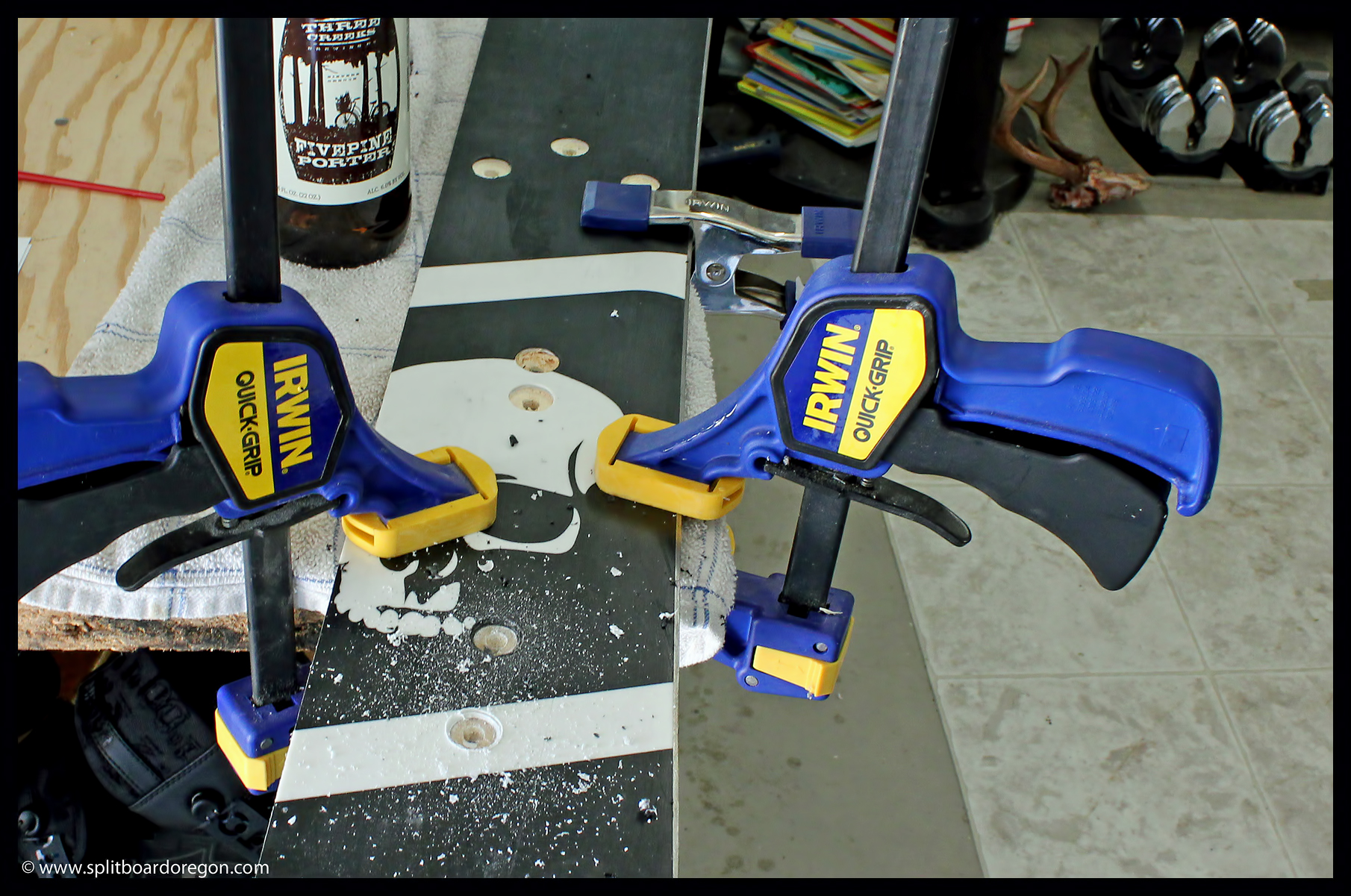
After the base repairs were complete, I applied epoxy to the cut edge (inside edge) to seal the wood core from moisture, using the same mix as for the base. Placing tape along the base of the board allowed any excess epoxy to collect on the tape. Lastly, I added the Karakoram board clips to complete the project. Most people add these first, but I just used masking tape when needed during the construction process, and added the clips at the end (I did check my drill job though initially to make sure all was well). Finally, I cleaned the base with a citrus solution, waxed it up, added the Spark Burners, and it’s ready to ride! Here’s a pic of the board complete again…
And of course, I took a few photos of the board in tour mode….
Burton Custom Split
The following describes how I converted my old 160 cm Burton Custom into a splitboard that I’ve used in places like Tombstone Pass, Mt Hood, Diamond Peak, etc.
I then applied a few layers of two part epoxy to the exposed wood core and exposed inserts. Each layer takes about a day to dry. I used 655-K West Systems Epoxy and found it to be very good. My next step was to mount the hooks. I taped the two board halves together along the entire board, with some tape running across the board in three or four places as well. The Voile templates I used worked fine, and I was able to mount the hooks in place easily. I did epoxy the holes after drilling to ensure water would not enter the core.
Next, I mounted the touring brackets on each board half. First, find the center of the board by the balance test, and then apply the Voile sticker template. After center punching the sticker holes, I drilled the 1/4 inch holes through the board and followed up by using a 3/4 countersink wood bit through the base and just into the core. I went into the core about 1/8 inch so I could use metal p-tex to fill the holes. I coated each hole in epoxy and then pounded the t-nuts into place. Repeat for the other board half.
I followed the same procedure for the heel lifters (different drill bit), though in hindsight I think I could have got by without using the t-nuts and just used wood screws, as there isn’t a lot of stress on the heel lifters. This would have resulted in a few less holes in my base that needed patching. Here’s a shot of a base patch:
Tip clips were next, and these went on pretty easily. The template worked fine and I used a hammer and the Voile pins to flare out the metal on the base side. Next, I went to work mounting the bindings. This proved to be the most difficult part for me. I opted to use t-nuts and screws instead of the wood screws as I figured this will be a more bomber setup. I used the Voile templates and made a slight adjustment for my rear foot since I ride a slight duck stance. I ended up having my slider pucks slightly offset from my drilled holes.
In hindsight, I definitely would have spent the extra $$$ on the factory pucks (this would allow some adjustability and two holes in your base per puck instead of 4). For my bindings, I used 1/4 x 5/8 inch flat head screws and 1/4 inch t-nuts. This seemed to work well. With Burton’s hole pattern, I ended up hitting metal in a few places. I was able to drill some of it out, but not all and again think some of this could have been avoided with the use of factory pucks. You can see the metal in the lower left hole in the below picture:
Again, I coated the holes with epoxy:
I wasn’t able to utilize any of the existing holes to get my stance setup the way I wanted, so I just drilled 4 holes per puck, which meant more patching. I filled the factory holes with epoxy:
For the few holes with a little metal, I cut off one sharp corner of the t-nut and positioned the nut in the hole and pounded away. Then, instead of metal p-tex, I used epoxy mixed with some black epoxy pigment to get the black color to match the other holes. A sharp razor let me get the filled holes flush with the base:
I had to drill out the Voile pucks a little bit to get the puck holes to line up with the t-nut holes, but then had a hell of a time getting the bindings mounted. I finally figured out I had to shim and sand the pucks. I used some of the old rubber from my Voile slider tracks under the pucks for a shim. This allowed me to mount the bindings. Here’s a shot of the finished board top and base:
Finally, I mounted my Sparks and am mostly finished. I still need to apply a little more epoxy to a few spots and wax the base before I’m ready to go.
Tognar Toolworks had all the materials I needed for my project except the epoxy. Here’s the website: